

Product teams play a key role in solving user problems and achieving product success. But who should lead the team and manage its work? The Head of Product, the product manager, or someone else? In this article, I explain why product teams should be self-managing. I describe the benefits this approach offers and what it takes to succeed at self-management.
Listen to the audio version of this article:
What is a Self-Managing Product Team?
A product team is a group of people who work together, have ownership of a product, and are responsible for making the product successful.[1] Traditionally, the team is led by a senior manager, like the Head of Product, or by a product manager.[2] They set product goals/OKRs, coordinate the work of the team members, and ensure the team is on track. While this approach works, there is a better way: using self-managing product teams.
On such a team, leadership is shared amongst the members. They are collectively responsible for progressing the product and meeting agreed outcomes. Consequently, they collaborate to identify and manage the necessary tasks and improve their way of working.[3] Figure 1 illustrates the two approaches.

Self-managed product teams can be more effective than manager-led ones, as they offer the following three benefits: [4]
- Better decisions: “None of us is as smart as all of us,” Ken Blanchard rightly noted. Empowering the team to own their work, set product goals, and determine what needs to be done leads to better decisions and increases the chances of offering a successful product.
- Increased productivity and motivation: Owning the work and deciding what to do leads to more productive and motivated teams. As Steve Jobs once said, it doesn’t make sense to hire smart people and then tell them what to do.
- Reduced workload for the Head of Product or product manager: Asking the team to manage their work allows the individual to focus on their core responsibilities. It prevents them from becoming overworked, turning into a bottleneck, and delaying decisions.
But Does Self-Management Actually Work?
If you have applied agile practices, you are likely to be familiar with the concept of self-managing development teams. But you might also have had bad experiences and doubt that the approach actually works.[5]
I have certainly seen my fair share of teams that struggled to self-manage. Some suffered from slow and long-winded decision-making processes, while others underperformed and lacked accountability. In some cases, the teams never became truly self-managing. They always had to rely on an individual to tell them what to do.[6]
However, I have also seen plenty of teams succeed at self-management. What distinguished them from those who struggled? The successful teams had been set up effectively and received the support they needed.
Self-management doesn’t happen by chance, and telling a team to self-manage isn’t enough. For many organisations, self-management is still comparatively new—it has to be encouraged and learned. To help you establish successful self-managing product teams, I’ve put together six practical tips, which I’ll discuss in the remainder of this article.[7]
Tip #1: Choose the Right Team Design
How teams are set up has a profound impact on their performance, as research by the late Harvard professor and team expert J. Richard Hackman shows.[8]
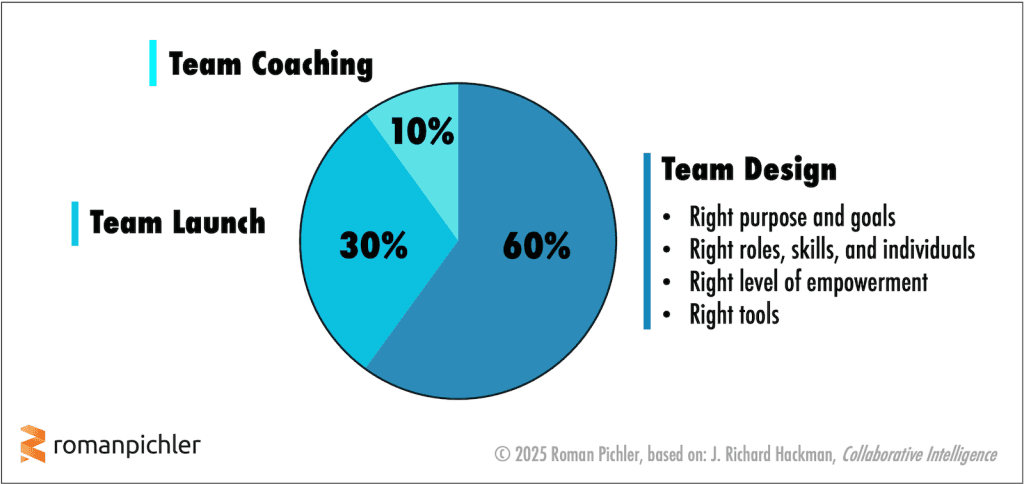
As Figure 2 illustrates, the biggest influence on team performance, about 60%, is the team’s design. This includes ensuring that the right people join the product team, that the team’s goals and authority are clear, and that the team receives the right support.
The second biggest influence comes from the team launch, roughly 30%. This includes helping the team members bond and establishing shared ways of working. The third factor, team coaching, finally, has a comparatively small impact, about 10% according to Hackman. This does not mean, however, that it is unimportant. The opposite is true, as I’ll explain later.
While Hackman’s insights are generally applicable, getting the team design right is especially important for self-managing product teams. Why? The lack of a single leader means that shortcomings in the design are even harder to compensate for than on a manager-led team: There is no one who tells people what to do and sorts out problems for the team.
To put it differently, if you want product teams to self-manage successfully, you must put the right foundations in place and ensure that the teams are set up effectively, as I explain in more detail in the article Setting up Product Teams for Success.
A key consideration when designing a team is to choose the right level of authority, as shown in Figure 3. The minimum empowerment a product team requires is owning the product discovery and delivery decisions. This allows the members to set specific product goals/outcomes, determine the features and UX of the product, and guide their implementation.
While this level of empowerment can be sufficient, I recommend increasing it further and granting the team the authority to make strategic product decisions. This gives the team full-stack ownership of the product. It allows the group to own and solve customer problems and progress the product quickly. Consequently, they each become (mini) growth engines. I explain how to make this approach work in the article Strategy and Product Teams.

But no matter which empowerment level is right in your context, make a conscious choice and clearly communicate the team’s authority to its members, the stakeholders, and the rest of the organisation. This will not only impact the team’s work and the decisions it can take. It will also affect how the team is staffed and which roles and skills are required.
Tip #2: Encourage Disciplined Collaboration
Self-management does not mean that everyone can do whatever they want, and it has nothing to do with working in a chaotic, unorganised way. Instead, it requires disciplined collaboration. This includes the following:
- Working on shared goals. The key goals for a product team are product vision, user/customers and business goals, as well as product outcomes/OKRs. The first set of goals might be captured on a product strategy, the second one on an outcome-based roadmap. To facilitate collaboration, all team members should work on the same product goal at any time.
- Establishing common processes to work together effectively, including how to make joint decisions and how to identify and track team tasks.
- Running collaborative workshops to make and review decisions, coordinate the work, and improve processes. I find that attending quarterly strategy workshops and participating in sprint reviews are beneficial for product teams.[9]
- Using common tools to capture key decisions and track the work, for example, my Product Vision Board to articulate the vision and product strategy and a Kanban board to visualise and track the team tasks.
To get organised and collaborate well, the team will greatly benefit from an experienced coach, as I’ll explain in tip #6.
Tip #3: Empower the Product Manager to be Primus Inter Pares
Deciding together helps product teams collaborate and make better decisions. But as beneficial as it is, it has a dark side: Teams can spend a long time trying to reach an agreement. In the worst case, a team gets stuck in endless arguments and is unable to move forward. I therefore recommend empowering the product manager to decide when no agreement can be reached. Often, “more is lost by indecision than by wrong decision,” as Marcus Tullius Cicero noted.
This makes the product manager primus inter pares, first among equals, as shown in Figure 4. As with any special power, it should be applied carefully and used as a last resort when a team is unable to agree despite having tried hard. What’s more, it does not grant the product manager positional power. The individual is not the boss of the other team members.[10]

Tip #4: Establish Shared Leadership within the Team
While it is helpful to empower the product manager to have the final say if no agreement can be reached, it would be wrong to think that the individual should be the team leader. This would prevent self-management and result in a manager-led product team. Instead, the team members should share leadership and lead in their respective areas of expertise—think of a flock of geese flying in a V-formation and rotating the lead position.
For example, the product manager offers product leadership and guides product decisions. This includes ensuring that an effective product strategy and actionable product roadmap are available and that the right KPIs are used. Compare this to the tech lead who champions the technical decisions and ensures, for instance, that the right architecture and technologies are chosen.
If you work with an extended product team that comprises key stakeholders—which is something I recommend—then they exercise leadership, too. For instance, the marketer leads the marketing work, and the sales rep leads the effort to create and implement the right sales strategy. Figure 5 shows different product team roles with their leadership contribution.[11]

Tip #5: Provide the Right Guidance to the Team
Establishing shared leadership within the product team is great. But it’s not enough. A product team also needs direction and support from outside. This can be achieved, at least in part, by using an overarching strategy and overall goals that direct the team and its work. Figure 6 shows how this can be done.
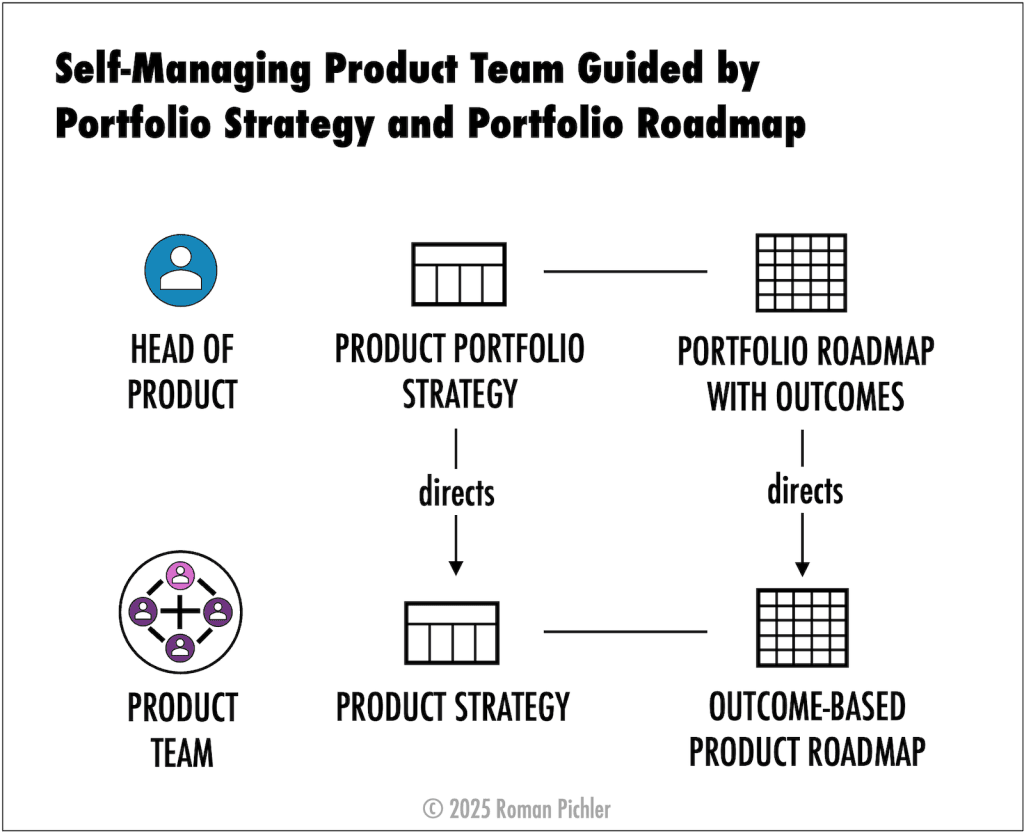
In Figure 6, the Head of Product manages a product portfolio strategy and an outcome-based portfolio roadmap. The product team has ownership of the product strategy and product roadmap. These are, however, directed by their portfolio counterparts: The product strategy must follow the portfolio one, and the product roadmap must adhere to its portfolio plan. To put it differently, the product team must implement the overarching portfolio strategy and roadmap. This way, the team receives the necessary direction, and different teams are aligned, while the individual product teams have full control over their products and innovate quickly.[12]
Tip #6: Use a Skilled Team Coach
While a team coach is helpful for any team, it’s essential for a self-managing one. All successful self-managed teams I have seen over the past 20 years were supported by a skilled coach.
As I mentioned earlier, self-management does not happen by chance. Teams have to learn how to organise their work and set and meet shared goals. A team coach plays a vital role in this, as they offer the following support to the team.
- Ensure that team goals, roles, and responsibilities are understood.
- Facilitate team meetings, including strategy workshops and team retrospectives.
- Help the team members communicate and work together effectively.
- Help the team to make decisions collaboratively and reach sustainable agreements.
- Teach the team how to deal with conflict constructively and use disagreements as a source of innovation.
- Help the team continuously improve its performance, processes, and tools.
- Encourage people to practise sustainable pace and stay healthy and motivated.
I am aware that some organisations have bad experiences with coaches, especially on agile teams. But my experience suggests that if you choose coaches with the right skills and give them the support they need, their impact more than justifies the cost incurred.[13]
The team coach role might be filled by an experienced agile coach, Scrum Master, product coach, or another individual with the right skills. In some cases, the Head of Product or a senior product manager, also referred to as lead or group product manager, might be able to act as the team coach, at least temporarily.
Notes
[1] A product team, as discussed in this article, differs from a product management group and a development team. The former is an org unit; the latter is tasked with designing and building a product.
[2] The Head of Product role is also referred to as Chief Product Officer (CPO), Director of Product Management, and Vice President (VP) of Product Management, depending on the size and structure of the company.
[3] Different authors have suggested different definitions of what exactly a self-managed team is. Renown team expert J. Richard Hackman states in his book Leading Teams: “Self-managing teams have responsibility not only for executing the task but also for monitoring and managing their own performance. Managers set the direction for such teams but give members full authority for all other aspects of the work.” Marty Cagan writes in his book Inspired, 2nd ed., that a product team should have “an intentionally flat organizational structure.” But he stops short of suggesting that it should be self-managing.
[4] This is not a new insight but has been known since at least the early 1990s. For example, Susan G. Cohen’s research paper The Effectiveness of Self-Managing Teams was published in 1993 and states that “(…) self-managing groups are more effective than traditionally-managed [sic] groups.”
[5] Self-managing teams are not an agile invention but precede frameworks like Scrum and Extreme Programming, see footnote 4.
[6] Sadly, many agile teams I saw never received the necessary support and guidance, be it that they did not have a Scrum Master/agile coach, or the individual lacked the skills and/or capacity to effectively support the team. Unsurprisingly, the teams struggled to self-manage and, in many cases, underperformed.
[7] Note that I focus on those practices that are especially important to facilitate self-management. I intentionally don’t cover foundational practices for creating effective teams to prevent this article from turning into a book.
[8] J. Richard Hackman, Collaborative Intelligence: Using Teams to Solve Hard Problems.
[9] This assumes that the team is empowered to make strategic product decisions.
[10] You can find out more about strengthening your ability to lead the product team members by reading the following articles: How to Strengthen Your Authority as the Product Manager, Decoding Product Leadership, and Leading without Being the Boss.
[11] Note that you may have to amend the roles for your product and organisation. A product team that looks after a supporting, technical product like an internal software platform is unlikely to require a UX designer, marketer, and sales rep, for example.
[12] Empowering a product team to own the strategy of their product and directing them with a portfolio strategy and roadmap balances autonomy and alignment, as I explain in more detail in the article Strategy and Product Teams.
[13] J. Richard Hackman argues in his book Collaborative Intelligence that team-focused coaching is necessary for any team to be effective.
Post a Comment or Ask a Question