

AI has significantly impacted product management. But so far, most product teams have used it to create new features and discover and deliver products faster. While helpful, this approach overlooks the area that most determines product success: strategy. In this article, I’ll explain how to move beyond execution and use AI as a strategic partner—helping you create a product strategy that achieves lasting success.
Listen to the audio version of this article:
Why Product Strategy Matters Now More Than Ever
I’ve worked in tech for nearly 30 years, and I can’t remember a time when the industry was more dynamic than it is today. Even the Internet craze in the late 1990s seems lame in comparison. Given that we now have powerful AI tools available that can analyse huge amounts of customer data and allow us to create full-blown prototypes faster than ever, you might be wondering if you still need a product strategy.
While a lot has changed over the years, one thing remains the same: If you don’t know where you want to go, you will struggle to choose the right path and move forward effectively. In a product setting, the product strategy captures what you want to achieve and how you might get there. Think of it as a set of specific choices that guide product discovery and product delivery. Such a strategy should answer the following questions:
- Who is the product for? Who are the users and customers?
- Why would people want to use it? What problem does it address, which benefit does it offer, or which job does it help people do?
- How will the product benefit your business? Will it, for example, generate revenue, reduce costs, or increase productivity?
- What sets it apart from alternatives? What are its standout features?
While having an effective product strategy has always been important, it’s even more crucial in the age of AI. Here is why:
- The product strategy provides guardrails to make the right choices and decide what to build: There are a million ways to use AI and add it to a product, but not all of them make sense, of course. A product strategy helps teams discover how AI can actually serve their users and business. It helps them decide, for example, what experiments to run and what features to test. Without a strategy, you risk throwing stuff against the wall and seeing what sticks—trying out idea after idea and hoping that at least one will eventually be successful.
- It keeps teams and stakeholders aligned: Developers, designers, and stakeholders often have different ideas about what a product should do. The product strategy keeps everyone moving in the same direction, avoiding confusion and wasted effort.
- The strategy avoids tech for tech’s sake: It’s easy to get caught up in building something just because it’s cool and everyone else does it. A good strategy encourages teams to ask: Does AI truly benefit the users, and does it create a positive impact on the business?
- It guides responsible and ethical use of AI: With AI, issues like bias, privacy, and environmental impact matter more than ever. An effective product strategy addresses ethical risks and helps create a product that uses AI responsibly.[1]
If strategy still matters, how can we leverage AI to create a winning product strategy that achieves lasting success?
Put the Right Foundations in Place
Over the years, I’ve had an on-and-off relationship with running. There were times in my life when running was my main endurance exercise, and there were years when I didn’t run at all. Currently, I am enjoying running again, and I’d love to run faster and further. It’s tempting, then, to buy new super-trainer shoes. But footwear alone won’t make me a better runner. To run at a higher pace for longer and stay injury-free, I’ll have to take a more holistic approach, reflect on how I run, and improve my running technique. The same applies to product strategy and AI.
I wish I could tell you that with AI, making the right strategic decisions will be a breeze, that AI can do most, if not all, strategic thinking for you, and that you can easily prompt-engineer and vibe code your way to success. But that’s not the case. While AI can help you make better strategic decisions and reduce the time and cost required, you still need to know what decisions have to be taken and how to make them—just like I have to understand what a good running technique looks like to take full advantage of my new running shoes. The good news is that this puts you in control: You decide how to use AI, rather than being tool-led.[2]
While every product, team, and organisation is different, I’ve worked hard over the past 15 years to develop a strategy approach that is generally applicable.[3] Figure 1 visualises this approach.
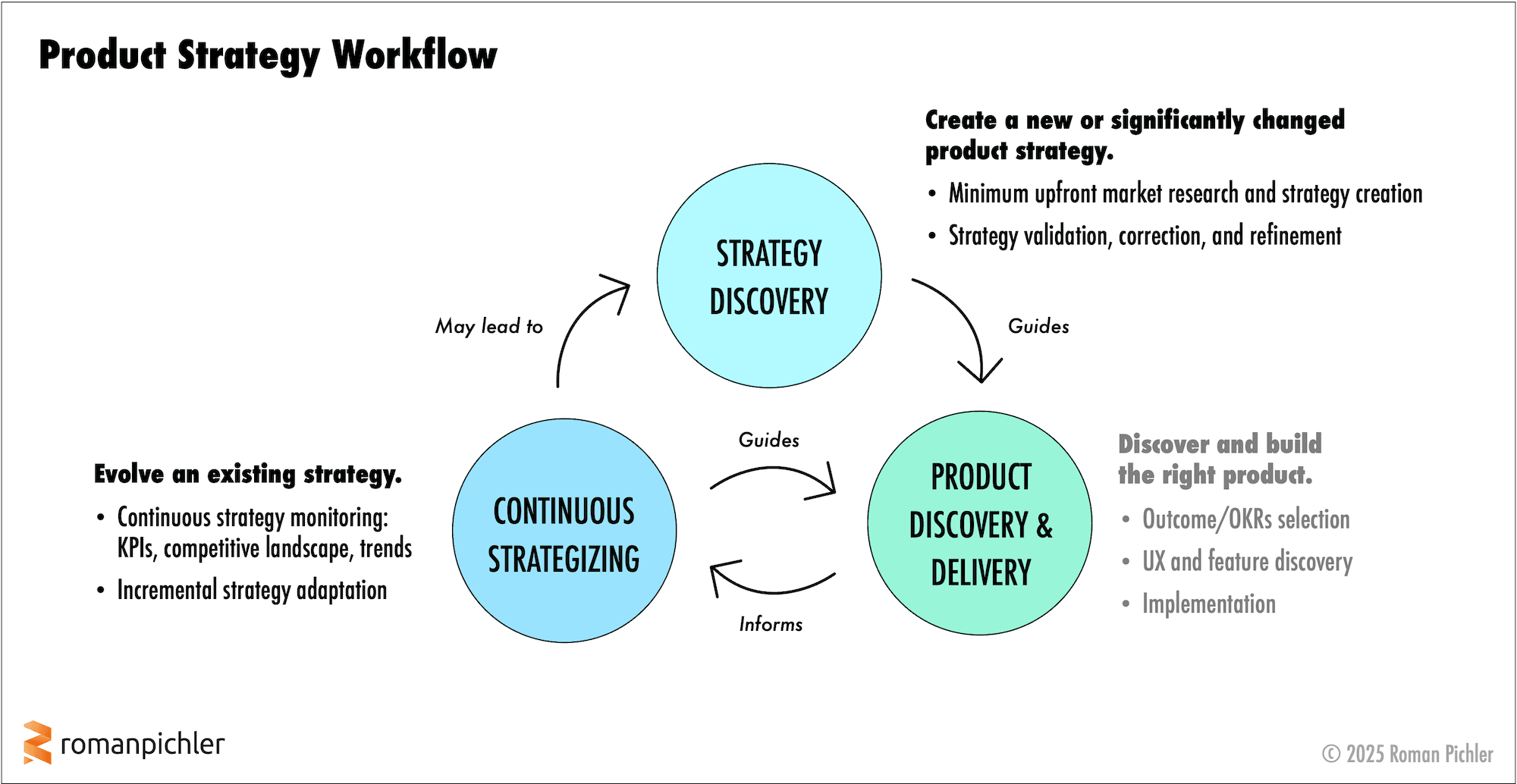
The first thing to notice in Figure 1 is that the strategy work is split into strategy discovery and continuous strategizing. The former helps you create a new or significantly changed product strategy, for example, to develop a brand-new product, achieve product-market fit, or move an existing product to a new market or market segment. This is best done by creating an initial strategy using a tool like my Product Vision Board and then iteratively correcting and refining it until its statements are free of major risks and assumptions and backed up by empirical evidence. Carrying out this work can take from a few hours to several weeks, depending on the amount of innovation and uncertainty present.[4]
Continuous strategizing, in contrast, systematically evolves an existing strategy. It views strategy as an integral part of the ongoing work product teams do, thereby enabling them to respond to opportunities and threats as early as possible. It achieves this by continuously monitoring the value a product creates, the competitive landscape, and relevant trends. Both types of strategy work require learning and adaptation, but strategy discovery adds experimentation to the mix, as I explain in more detail in the articles Product Strategy Discovery and Continuous Strategizing.
Next, let’s briefly look at the connections between the workflow elements in Figure 1. Strategy discovery sets the scene for product discovery and product delivery. It helps determine what product outcomes or objectives should be achieved and what features should be implemented. The insights gained in product discovery and delivery inform continuous strategizing and may lead to strategy adaptations. For instance, user feedback on the latest release might suggest that one of the standout features needs to be adapted.
At the same time, continuous strategizing guides product discovery and delivery. If it turns out, for example, that conversion is down, a new product outcome/objective might be introduced, and the product backlog might be updated. Strategy and product discovery are therefore connected and inform each other.
But continuous strategizing can also trigger strategy discovery for an existing product. For example, the threat of a new market entrant or the opportunity to exploit a new technology may necessitate a bigger strategy update, which requires the new strategy discovery work.[5]
Integrate AI into Your Strategy Work
With an effective strategy approach in place, you are in a great position to take the next step and decide where and how to use AI.
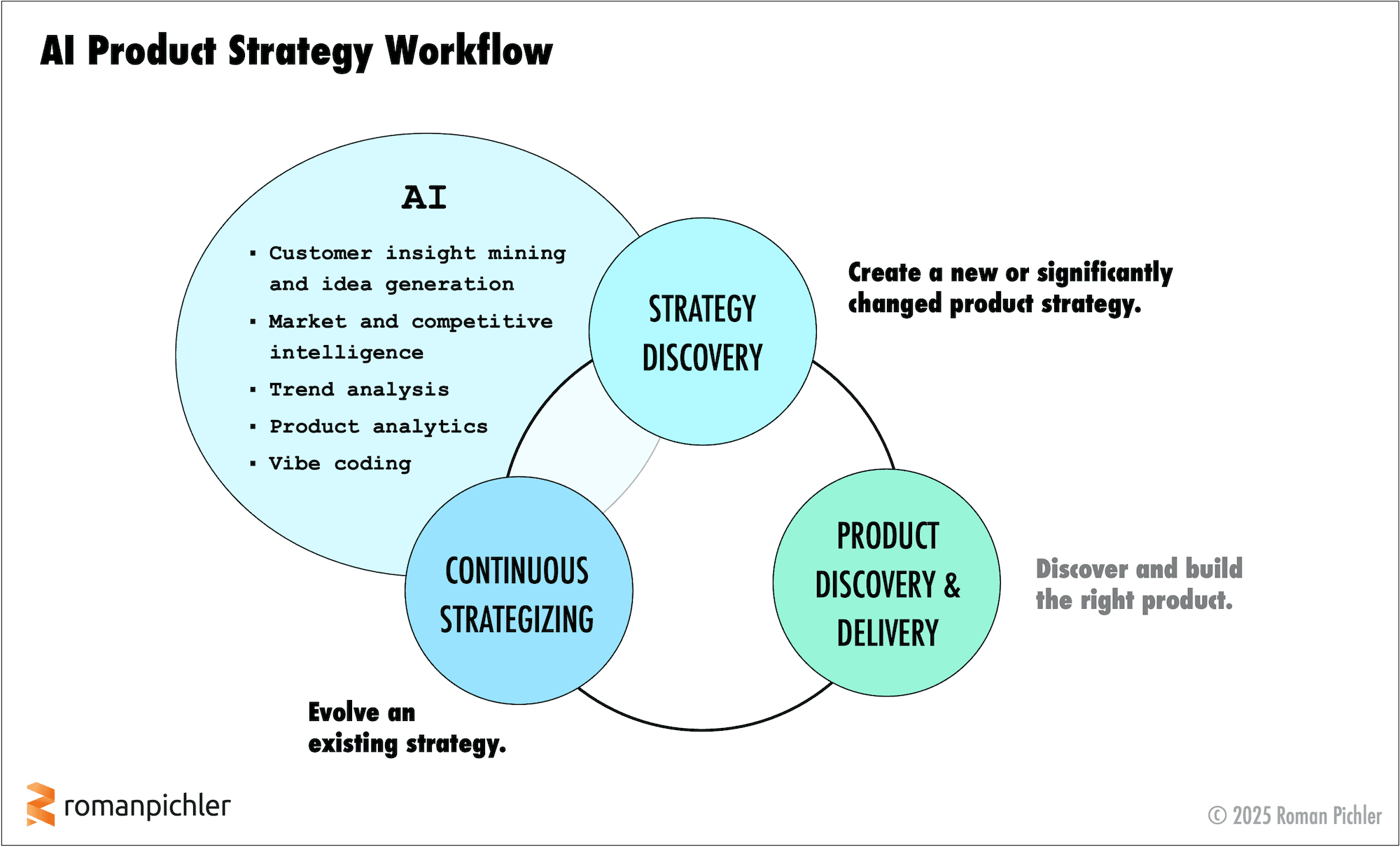
In Figure 2, the strategy work is powered by AI tools. These can support you in the following ways: [6]
- Market and competitive intelligence: Automating the tracking, analysis, and visualisation of competitor data and market trends. Tools that can help you with this include AlphaSense, Contify, Crayon AI, and Klue.
- Customer insight mining and idea generation: Extracting actionable insights from customer data, including interviews, support tickets, survey responses, and reviews. You might use ChatGPT, Claude, Dovetail and Insight7 for this.
- Trend analysis: Identifying emerging patterns and shifts in the market, customer behaviour, and industry landscape. Products that can help you with this are Brandwatch, Google Trends, and Sprout Social.
- Product analytics: Tracking user interactions, measuring the value a product creates, and determining if the strategy is still effective. Sample tools are Amplitude, FullStory, Heap, and Mixpanel.
- Vibe coding: Generating code from natural language prompts to test ideas quickly using, for example, Cursor, GitHub Copilot, Figma, and Loveable.
As Figure 2 illustrates, AI is applicable in both strategy discovery and continuous strategizing. What tools you use and how you apply them will differ, though, due to the distinct nature of the two elements. Strategy discovery is about innovating to a larger extent, whereas continuous strategizing focuses on incremental strategy changes. Experimentation and vibe coding are therefore relevant for the former, but not necessarily for the latter. Similarly, using product analytics to check if the strategy is still effective is very helpful for continuous strategizing, but not for strategy discovery.[7] This shows again that you have to understand what the strategy work involves so you can choose the right AI tools and apply them effectively.[8]
| What about Scenario Planning and Persona Generation? I haven’t listed strategy creation and scenario planning as an area AI can support you in, as I advise starting with what is the most plausible strategy and then iteratively testing and correcting it. This may lead to switching to a different strategy (pivot) and validating a new scenario. I generally don’t recommend thinking of all possible strategic options upfront and then testing them one by one, as this tends to be too time-consuming and expensive. The point is not to discover a perfect strategy but one that is good enough to create the desired value, knowing that it will have to be adapted sooner or later anyway. When it comes to person generation, I don’t recommend using AI. The reason is simple: To be effective, persona descriptions must be based on first-hand user research. What’s more, being actively involved in creating the personas, you deepen your understanding of the different types of users/customers and their needs. This, in turn, helps you make better strategic decisions. |
Be Aware of AI’s Limitations
As beneficial as AI can be, it would be wrong to think of it as a silver bullet and ignore its drawbacks. Here are four major limitations you should be aware of and consider when testing and using AI tools:
- Lack of empathy and intuition: AI is no replacement for interacting with real users and customers. To make the right strategic decisions, you must have a sound understanding of their needs and be able to empathise with them. This is best achieved by using methods like direct observations and customer interviews.
- Data dependency: AI tools require enough good-quality data to generate helpful results. If you don’t have sufficient data available or if the data quality is not right, AI tools won’t be able to help you. This is the case for disruptive innovations, which not only create a new product but also a new market—like the original iPhone did, for example.[9] Similarly, you may struggle to apply some AI tools for bespoke and in-house products with a small user base.
- Incorrect results: AI can confidently present plausible-sounding market sizing, customer quotes, or case studies that are actually fabricated. Gen AI tools also give the most likely answers, not necessarily the correct ones. Their predictions are based on degrees of confidence rather than absolute certainty. What’s more, AI tools often draw from generalised patterns. This can lead to generic strategies that mirror industry averages but fail to achieve effective differentiation.
- Ethicality and privacy issues: AI tools might have been trained with data that contains biases. This can lead to discriminatory outcomes and wrong results. Additionally, feeding sensitive market, customer, or company data into AI tools, especially external ones, can create privacy and compliance issues, as well as IP leaks. Last but not least, AI consumes large amounts of energy and requires additional hardware and new data centres. Using AI might increase the carbon footprint of your company and threaten its environmental commitments.
Summary
In a rapidly changing world, strategy is more important than ever. It brings clarity and empowers teams. AI is a strategy accelerator, not a strategist. It does not replace human strategic thinking; it can amplify it.
AI is therefore best used as a co-pilot that helps you make the right strategic choices. To achieve this, you must be in control and understand what an effective product strategy is and how it should be created. To take full advantage of AI, purposefully build it into your strategy workflow rather than bolting on individual tools.
Additionally, don’t ignore AI’s limitations. Combine its efficiency with customer empathy and market immersion. Don’t skip direct user and customer interactions and carefully review AI-generated insights before you use them—especially for strategic decisions.
Notes
[1] I recommend assessing product strategy for ethical risks and addressing them during strategy validation in my book Strategize, 2nd ed. See also my articles Product Ethics and AI and Product Strategy. The former offers an overview of the approach; the latter discusses the environmental impact of AI.
[2] I am not the only person to suggest that the effective application of AI requires a suitable workflow or process to be in place. Jason Riggs argues in his book The MACH-10 PM: AI-Powered Product Management at Hypersonic Speed that teams need a strategy loop to use AI tools successfully.
[3] I first wrote about the two different strategy elements in the article Establishing an Effective Product Strategy Process published in 2018, and I describe them in my book Strategize, 2nd ed.
[4] The main difference between strategy discovery and product discovery is, simply put, that the former comes up with a product strategy to successfully create or progress a product, whereas the latter determines the right features and UX. Both require experimentation and learning. But strategy discovery investigates the problem space, whereas product discovery focuses on the solution. For more insights, see my article Product Strategy and Product Discovery.
[5] The Head of Product, aka CPO, VP of Product, and Director of Product Management, should lead the effort to establish an effective strategy approach for the products offered.
[6] I don’t have any affiliations with tool vendors, and I don’t receive any benefits from mentioning the tools. I only state them to make the discussion more concrete and help you get started with integrating AI into your strategy workflow. Carefully test any AI tools and select those that work best in your context.
[7] To understand if the strategy is working and if the product is generating the desired value, the strategy must have been implemented, and the resulting product must have been deployed.
[8] While AI tools automate some strategy tasks, you still have to allocate enough time to carry out the work required. I recommend allocating up to four hours per week for the person in charge of the product and two hours per quarter for a collaborative strategy workshop that also includes the key stakeholders and representatives from a cross-functional development team.
[9] You might not be terribly concerned about disruptive innovations. But this would be a mistake. Companies should spend about 10% of their innovation effort on these innovations, as I explain in the article The Innovation Ambition Matrix.
Post a Comment or Ask a Question