

The vision plays an important role in bringing a new product to life: It acts as the overarching goal guiding everyone involved in the development effort. Equally important is the product strategy, the path chosen to attain the vision. Without a shared vision and an effective strategy, people are likely to pull in different directions, and the chances of creating a successful product are slim. While vision and strategy are key, describing them can be challenging. This post introduces the Product Vision Board, a tool that helps you capture the vision and product strategy.
A Sample Vision Board
Towards the end of 2012, I was exploring the idea of creating a software-based version of my product canvas tool that integrates seamlessly with other tools like JIRA and GreenHopper. To get started, I created an initial product vision board, which is shown below.
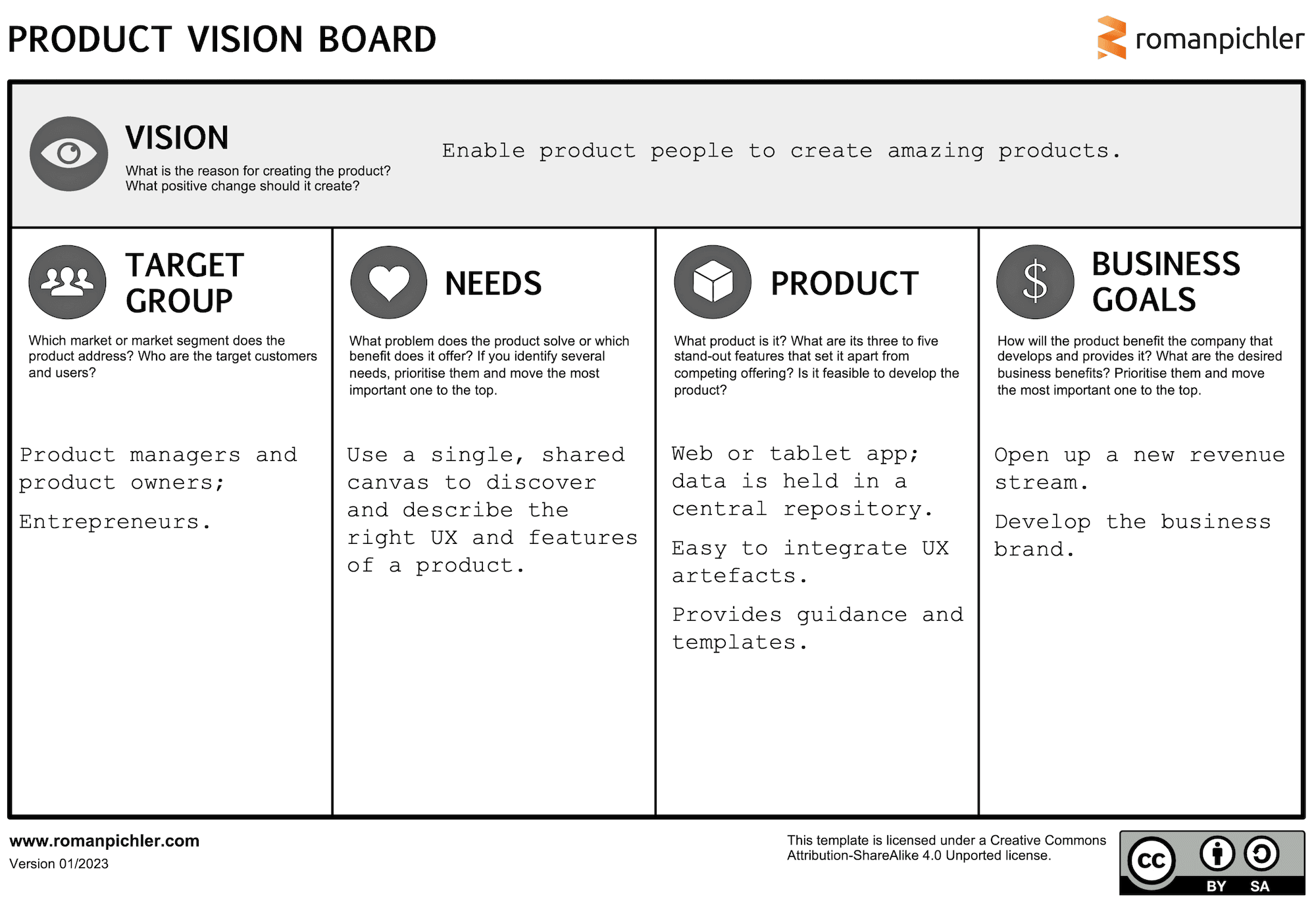
The Product Vision Board above captures my assumptions about the users and the customers of the new tool, the needs the product should address, the key product features, and the value the product should create for my business. (I explain the sections of the board in more detail below.)
As you may have noticed, I have kept the information on the board concise. I did not, for instance, write personas and user stories, or create a design sketch. There are two reasons for this: First, I did not know enough about the users and customers at the outset to write personas and to describe the product in more detail. Second, I find that the product details are best captured in the product backlog.
The board was very valuable: It helped me think through my idea, and it allowed me to share my thoughts with my team and with our development partner. Additionally, the product vision board helped me investigate the greatest risks by testing my assumptions, as I explain below. I now use the board for any new idea, be it writing a new book, creating a new brochure, or updating a training course, and I help my clients apply the board.
The Vision Board Explained
The product vision board is the simplest thing that could possibly work to capture the vision and strategy of a product. It uses five sections as shown in the following diagram and explained below. You can download the template together with a handy checklist from the tools section of my website.
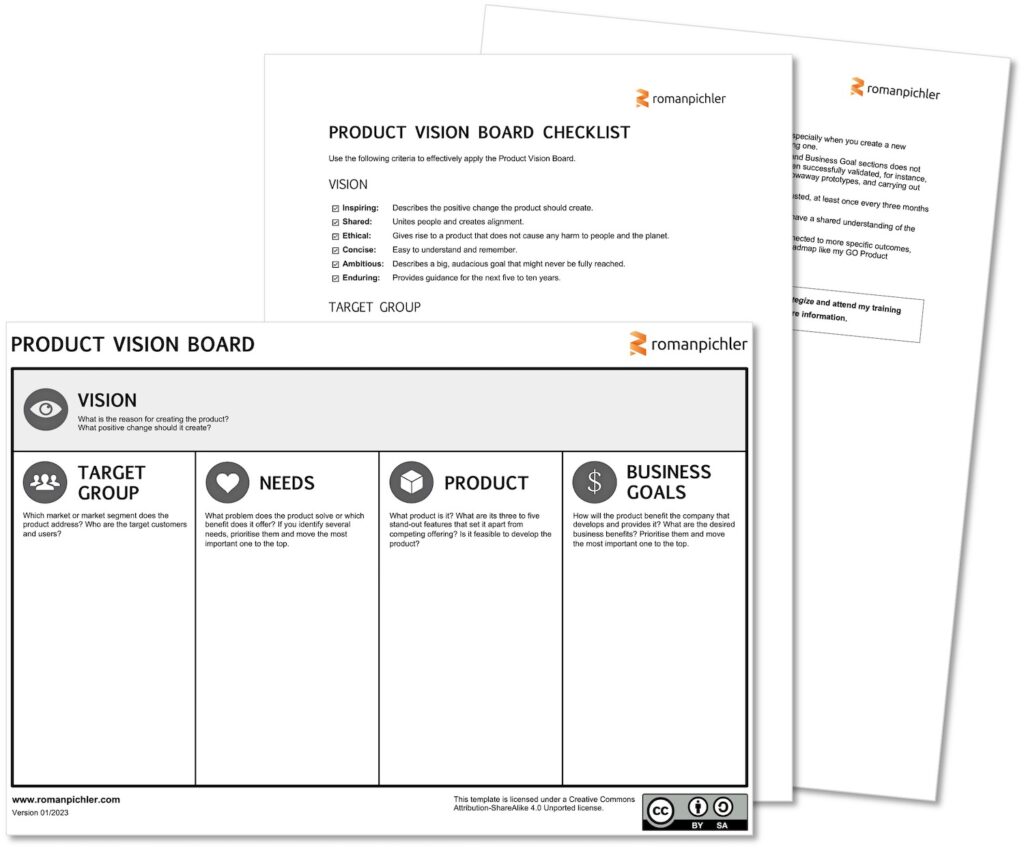
Vision states your overarching goal, the ultimate reason for creating the product, and the positive change you want to bring about. Make your vision big and inspiring; use a brief statement or slogan; and ensure that the stakeholders and development team(s) support it, that it is shared. For more vision tips, please see my article 8 Tips for Creating A Compelling Product Vision.
Target Group describes the market or market segment you want to address. You should state who the product is likely to benefit, who its users and its customers are. Choose a homogenous, clear-cut target group, especially when creating a new product.
Needs describe the product’s value proposition: the main problem the product addresses or the primary benefit it offers. The section should make it clear why people will want to use the product or pay for it. Capture what success looks like for the users and customers. If you identify several needs, prioritise them.
Product summarises the three to five features that make your product stand out and that are critical for its success. These are likely to correlate to its unique selling proposition, and they should address the needs identified. Don’t make the mistake of listing lots of features. Stick to a maximum of five. Capture the product details at a later stage in your product backlog.
Business Goals, finally, explain why it’s worthwhile for your company to invest in the product. It states the desired business benefits, for instance, increase revenue, enter a new market, reduce cost, develop the brand, or acquire valuable knowledge. The latter can be just as valuable as the former: When Toyota shipped the Prius in 1997, for instance, the car was not earning any money. But it immediately developed its brand (“green car company”), and had gained an advantage in hybrid technology. Prioritise the business goals to create focus and state targets. Otherwise, it’s hard to measure the product performance and apply the right key performance indicators (KPIs).
There are, of course, other helpful tools available that help you capture your ideas, including Ash Maurya’s Lean Canvas and Alexander Osterwalder’s business model canvas. I may be biased, but I like the simplicity of the Product Vision Board: I find it beneficial to consider the target group, needs, key features and business goals when exploring an idea before thinking about monetisation and the business model.
You can learn more about the Product Vision Board by watching the video below.
Research and Validation with the Product Vision Board
The Product Vision Board is not only a thinking and communications tool, but it also allows you to test your assumptions and capture newly gained insights. To get started, I find it helpful to identify the greatest risk or biggest uncertainty on the board. This creates focus, and it enforces a fail-fast: figuring out quickly what works and what doesn’t, which assumptions hold true, and which don’t.
When I was working on my digital canvas idea, for instance, the greatest risk was initially misunderstanding the user needs and potentially building a product that does not provide much value. I consequently decided to test my user needs assumptions before exploring further what features the tool should provide, or how the product should be implemented. I hence started carrying out a series of problem interviews, structured conversations with a prospect to understand the individual’s problems and goals without referring to the solution, and engaged in a few direct observation sessions.
These measures helped me understand the target group better, and assess how much value a product canvas app with JIRA integration would provide. It also made me update and change the board to reflect my latest thinking, as the following picture shows:
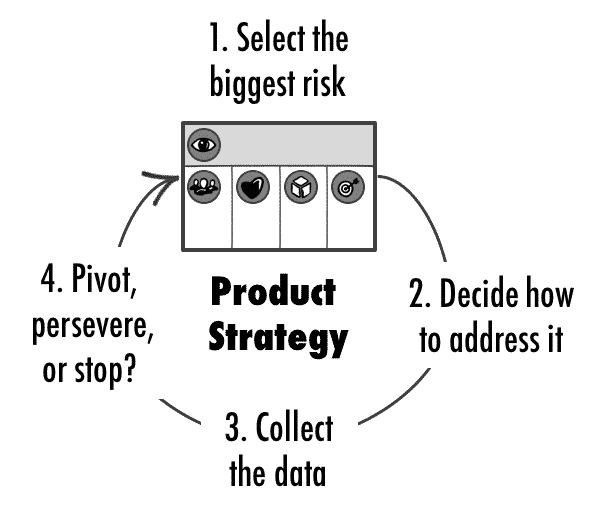
I suggest you follow a similar approach when you work with the Product Vision Board: Identify your biggest risk, and attack this risk first. Don’t be afraid to fail: Making mistakes is part and parcel of creating something new. What’s more, early failure facilitates fast learning, and it can save you time and money.
Product Vision Board and Business Model
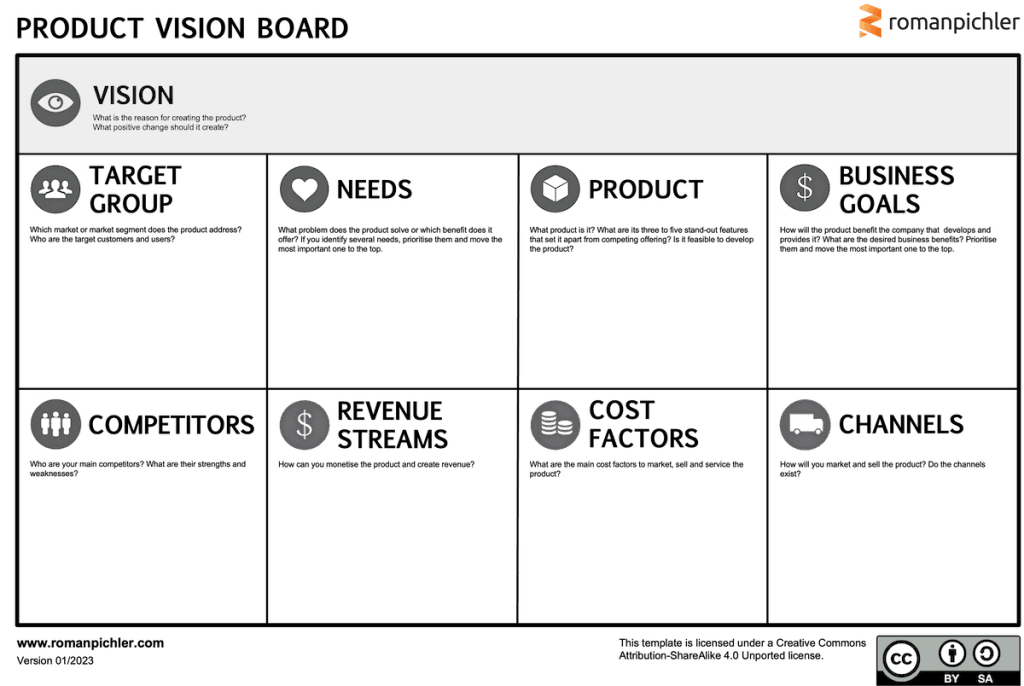
While a strength of the Product Vision Board is its simplicity, it does not detail how the business goals are achieved, and it does not capture the business model including the competitors, the partners, the channels, the revenue sources, and the cost factors. Describing and testing your business model ideas is particularly important when you develop a brand-new product and when you want to make bigger changes to an existing product, for instance, to take it to a new market (segment).
To capture your business model ideas you can either complement the product vision board with the business model canvas or use its extended version, the product vision board extended, which is shown below. The extended board is inspired by the business model canvas. You can download it for free from the tools section of my website.
Post a Comment or Ask a Question
54 Comments
The split between the vision and the four strategy boxes is what finally fixed things for us — what we had been calling strategy turned out to be a feature wishlist with dates on it. Filling in needs before the value proposition felt backwards at first, but it stopped the team from designing solutions for problems nobody had actually named. Still struggling to keep the business goals box down to two or three instead of eight.
Thanks for sharing your experience, Magiz. If you struggle to determine the right business goals, you may lack an effective business strategy. For more advice, take a look at the article Why Product People Should Care About Business Strategy. Hope this helps!
Hi Roman,
I just learned about the Product Vision Board, and am starting to read and watch as much information as I can find on it. How would you use this when the stakeholders are not clear on whether they need a product vision for a legacy application that still sits on a server? They are still thinking about technology requirements but they have stated they want a transformation. Is this the right tool for that? Are there other tools you can recommend?
Thanks for sharing your question, Simbella. In your case, I recommend starting with populating the bottom sections of the Product Vision Board. Clearly describe who the users of the app are, why they employ it, and which business benefits it generates. Do this exercise together with the stakeholders. Then ask yourselves if the strategy you have captured is the right one to move forward with or if you should change it. Hope this helps.
Hello Roman, I am using the dashboard and for the business goals quadrant you mention “Prioritize business goals to create focus and state targets”. What would those targets be? Thank you
Thanks for sharing your question Valeria. The business goals section encourages you to state desired business benefits the product should create. These include generating revenue, entering a new market and diversifying the business, reducing cost, and increasing brand equity. Which goals are relevant depends on the product: a revenue-generating offering typically has different goals compared to an internal, supporting one like a software platform.
Once you’ve determined the right business goals, you may want to quantify them and state, for example, how much revenue the product is expected to create in the first two years of its launch. If that’s not possible, then don’t worry: If you follow my model, you’ll break down the business goals into smaller, more specific outcomes on your product roadmap. Hope this helps!
Hi Roman: I was wondering about how best to fill out the target customer segment for B2B. It is a bit confusing having both customers and users listed there. Should I just put the target B2B buyer personas? Buyers are not the same as our users. I see many B2C examples and discussion in the videos and pages but almost nothing B2B. Would you say these segments are the audience for B2B customers / group of stakeholders to influence, e.g. marketing directors?
Thanks for sharing your question Suzanne. If the users and customers are separate groups, then I recommend describing them separately in the target group section of the product vision board. Take a medical device like an X-ray machine. Its users are the radiologists but its customers or buyers are likely to be hospital trusts. Consequently, you would create two separate entries in the target group section, one for the radiologists and another one for the hospital trusts. You can indicate which group takes priority by moving it to the top of the section. As a rule of thumb, I like to give priority to the users. Here is why: A product is unlikely to achieve sustained success if it does not do a great job for the people who work with it.
Stakeholders, however, are not captured on the board. Instead, perform a stakeholder analysis using, for example, the power-interest grid, involve the key stakeholders aka players in important product decisions, and ask them to join the product team. Hope this helps!
Hi Roman, Thank you for your reply. You have clarified which is great. By stakeholders I actually meant potential B2B buyers in the market not internal stakeholders. Very hard in our market to involve B2B potential buyers as we are actually trying to sell to them in a very competitive space, often with procurement depts involved. Thank you for the power interest grid reference though.
You’re welcome Suzanne. As the person in charge of the product, I recommend exploring how you can directly connect with prospective users and customers/buyers. Receiving information from other groups like procurement is great. But to empathise with the beneficiaries of your product and deeply understand their needs, you need to directly reach out to them, as I discuss in the article 5 Tips for Building Empathy with Users. Good luck with the product vision board and your strategizing work!
Hi Roman,
You mention don’t be afraid to fail. Can you tell me what constitutes as failure here during the early stages of defining the problem?
Thanks for your question Paris. Failure in the context of the article means finding out the one or more statements on the product vision board are wrong and possibly, that the strategy chosen will not work. As I write in the article, “figuring out quickly what works and what doesn’t, which assumptions hold true, and which don’t.” It’s important to accept that the initial product strategy might be wrong and not to cling to our preconceived ideas. Otherwise, we are in danger of building a product that nobody wants and needs. Hope this helps.
Nice post
Thanks for the feedback Sumaiya. Great to hear that you liked the article.
Great Article. I have used the Product Vision Board and JBTD for some years mainly related to B2C products but now are confronted with the challenge to define a product vision for B2B2C for a well established product. So how would I define the target groups and needs for 2 different type of customers e.g. insurances and insurees?
Hi Joe, Thank you for sharing your feedback and question. The answer will depend on the nature of your product. If your product was integrated into a larger offering and acted as a feature, I would prefer to work with one product vision board that focuses on the end users and their main need/primary job. An example might be a search capability that allows people to find the right insurance on an insurance company’s website. But if it was a supporting product like an internal platform or database/storage system, then I would create a separate board, whose target group would consist of the developers (users) and procurement (customer) of the other business.
Does this help?
Amazing Article !!
I have been struggling to find a simple blog that explains these concepts at one place ! Loved your work – Thank you ! Really helped me to have perspective and tools and get started …
Thank you for your feedback SM. Glad that you found the article helpful.
Hullo, Roman,
In a recent class of mine, the students and I had a closer look at the extended vision board, and we were wondering about the order of elements in the second row.
We observed that there is a coupling between:
a) target group and channels (who are the people and how to reach them best?)
b) needs and competitors (what needs to satisfy? who else to satisfy them?)
c) product and cost factors (what to build? where to put our money to build it?)
d) business goals and revenue streams (what do we want? how to fund our ambitions?)
This would imply a different order of fields from what you are showing in the extended board.
What reasoning did you use to order the fields?
Thanks for your insight
Urs
Hi Urs,
Thank you for sharing your observation and question Urs. The simple answer is: There is no specific reason for the order of the fields in the second row of the extended board. I initially developed the simple product vision board. After using it for a while I thought that it would be neat to add relevant business model information directly to the board, rather than using a separate artefact like the business model canvas.
The correlation you observed makes a lot of sense to me, and I may well reorder the bottom row in the future. Thank you for making me aware of it. In the meantime, I would encourage you to customise the template to suit your needs. Reorder the elements as you find it most helpful, and feel free to add additional (business) model elements to it. I’ve always considered my templates to be starting point rather than a definitive solution. Please make sure, though, to show the license agreement on any new product vision board variant you create
😉.Hope this helps!
Hi Roman,
Congratulations on the post. I need to know who writes the Product Vision Board, who is responsible, with which partners should it be written?
Best regards,
Marco Noiman
Thanks for sharing your feedback and question Marco. I recommend that the person in charge of the product leads the effort to create, validate, review, and update the Porduct Vision Board. At the same time, the individual should involve the key stakeholders and development team representatives in order to leverage their knowledge, create a shared understanding, and maximise the chances of generating strong buy-in: People are usually more likely to support a strategy if they’ve had the opportunity to contribute to it. My favourite way to involve the stakeholders and dev team members is by running collaborative workshops,as I discuss in more deatil in my books Strategize and How to Lead in Product Management for more information. Hope this helps!
Hi Roman,
Thanks you so much for the amazing post. You have shown the simplest way to capture vision, product strategy and business goal. This really helps to validate and rework the product strategy before simply jumping on it, building the product, and spending time and money.
You’re welcome Maju. Thank you for your feedback. Glad the article was helpful for you.
Yes, this was exactly what I was looking for!
👍Thanks for the tips and tools. But I am wondering, what are the best practices for the next steps after the product board is filled in?
I was looking for something on your site that kind of outlines this but could not find it.
Would a high level view be the following: create a roadmap, break it down into the backlog, then schedule sprints with the items from the backlog?
thank you!
Thanks for the feedback and sharing your question Tony. Here is the process I like to use:
Does this help?
Hi Roman,
I am new to product canvas, and I found it great. Could product vision canvas be applied to physical products as well or just for digital ones?
Thanks
Thank you for sharing your question Amin. Short answer: yes 🙂 I have successfully used the Product Vision Board to describe the vision and strategy physical products and for services. Hope this helps!
Hi Roman!
I thought I had clear enough the difference between vision and business goals until I read the Toyota Prius example.
I’d say that being a “green company” is the vision rather than a business goal.
Anyways, could you help me to incorporate correctly both concepts?
Thanks in advance!
Hi Francisco,
Thanks for sharing your question. I agree that becoming a green, environment-friendly company can make a good company vision. I used the Prius example to point out that business goals can be of non-financial nature as in the case of brand development. In fact, I would argue that if your company vision was to become an environment-friendly business, then you should expect to see related business goals in your product strategies, as I explain in my article “Leading Through Shared Goals“.
Hope this helps!
Hi Roman,
I couldn’ t find the download for the extended vision board. It seems the links are always to the simple version. Did I miss something?
Cheers Josef
Thanks for your comment Josef. You can download the extended Product Vision Board by clicking on the arrows next to the download button. After clicking an arrow you will see the Product Vision Board change. Hope this helps. If you continue to have trouble, please contact me and I’ll send you a copy of the extended board.
HI Roman. I was wondering if this tool can be used for an IT Company who is looking to introduce a number of new product lines to it’s business. They need to really nut out the product strategy and roadmap but i wasn’t sure if you would use one vision board per product, or group the products?
Excellent question Diana, thanks for sharing! If the target group and value propositions are identical or very similar, and if the users tend to use more than one product of the product line or portfolio, as in the case of Microsoft Office, for example, then I recommend creating one overall portfolio strategy and derive individual roadmaps for the products from it. You can happily use the Product Vision Board for capturing the portfolio strategy if you wish. Does this help?
Hi Roman,
I am finding the product vision board a difficult process. Not so much about the template, but more about gathering and consolidating the vision.
I deal with a back-end legacy system that we are now developing ourselves, setup in multiple agnostics scrum teams (fortnightly sprints, monthly release with a month of hardening). The product globally provides forecasting, ordering and replenishment, is subject to a nightly intensive batch with stringent SLAs, but also has an on-line user community of around 100 people across various business units (logistics, buying, supply chain, stores, franchises, …)
As such, we do not have competitors, nor are part of typical revenue streams.
I am finding the GO Roadmap useful.
Any advice on how to use the vision board in our circumstances would be helpful.
Thanks
Nico
Hi Nico,
Thank you for your feedback and for sharing your question. As you have a product that serves different user groups like logistics and buying, I recommend that you state these groups on the Product Vision Board together with the main problem that the product solves for each group or the primary benefit it offers. This will result in a grid structure. Then complete the board and state its three to five key features or capabilities, and its business benefits, such as, generate revenue by helping sell physical products or reduce cost. Once you’ve done this, ask yourself if you have one cohesive product or if the user needs are so different that your product is likely to be an aggregate product or product bundle. To validate this assumption, research how different users interact with the product. For example, observe users and evaluate any analytics data you have. If the user journeys have little overlap, then you probably have a bundle, which you should consider breaking up the product. This is likely to involve some major architecture refactoring. But it gives you the advantage to evolve the newly created products separately at different speeds thereby better responding to user and business needs.
Does this help?
Hi Roman,
Thanks for the practical approach. I’ll try and come back to you.
Hi Roman.
Thank you for this post, I’m going to use a bit of a self modified version of the Vision Board in my head assignment in computer science. This helps me a lot by explaining my vision with my project in a simple and brilliant way. Thank you.
Thanks for your feedback. I am really pleased that the board works for you. Good luck with your assignment!
Hi Roman! Thank you for this really great post. I’m discovering a year later… but it’s still incredibly relevant.
To share my experience with you, at Planbox (we make an cloud-base agile project management tool), we work with agile- gotta live what you preach! We have an informal version of the Product Vision Board, and are currently working to formalize it.
What’s great about the Product Vision Board (or at least our informal version of it) is that it does not only help build the product, but it’s a great reference for presenting the product when you hire new team members. It also greatly benefits the marketing and sales functions, when you need to prepare for a pitch, develop your marketing messages, etc.
Amanda Fong,
Community Manager at Planbox
Hi Amanda,
Thanks for your feedback and for sharing your experience. Great to hear that working with the product vision board is beneficial for you!
Roman in a book that im reading about customer development it mentions a product vision as one of the very first things to do, it also recommends agile development and it being well suited to the customer development process, and the book also recommends the business model canvas, i can see how this will benefit me in the future, the combination.
Thanks for this article, a hope to create one similar to your example when im ready to.
Hi John, Glad you’ve found the post helpful. Product vision board is maybe a misnomer, as the board captures the product vision and the product strategy. Let me know how using the board works for you.
Hi Roman,
I have used your Product Vision Board successfully with a smaller internal project group which wanted to transform into a Scrum team.
After they had learned about Scrum, we needed just a few hours to set the vision, find out that they actually have a few different customer groups, and define the topmost features.
One of the most interesting discussions was the one about their value contribution and their business model, where they saw they had a rough idea, but would need to investigate more to come up with something supported by numbers. Even as internal team, they realized, if they can present that, it does not only make themselves happy, but also convince the management of their usefulness ,-)
Thank you very much for providing your Product Vision Board!
Best Regards
Andrea
Hi Andrea, Thanks a lot for sharing your experiences! The match mine: determining the value-added for the organisation can be tough but it’s usually very valuable.
This is great and I can see how this works for a new product. Does this work for existing products that are being enhanced or developed further though?
Hi Finn, Thanks for the feedback. Yes, it also worthwhile creating a vision board for a product update if the update addresses a new market segment, if additional needs are addressed, or if the business model changes.
Great post, Roman, thanks! I agree that simple, evolving tools that are visible to the entire team are really useful. I’ve shared this link with a team I know who is struggling with creating a shared vision. They have many of these elements, the just don’t have a discipline about putting them together in a visible place.
You might want to check out something similar I did for a recent Lean Startup weekend.
http://www.theapprenticepath.com/2011/04/05/our-lean-startup-machine-sketchboard/
best wishes,
– Lane Halley
Thanks for the feedback, Lane. I enjoyed your lean startup sketch board. Nice idea to integrate a sketch of the ecosystem including buyers and sellers – something that I do as part of the business model discussion on my vision board.
Great post Roman! We started using SCRUM about half a year ago at our company and as product owner I’ve been busy aligning our stakeholders and visualizing our product strategy. This is a very helpful post. Thanks!
By the way, if you would like to know how I’ve implemented your product backlog board. Check it out on http://bit.ly/eUoc26.
Hi Arran, I also recommend to my not-for-profit clients to consider how a new product or the next product version will benefit them. In that sense, the business model question still applies.
Hi Roman,
Poor visioning is a common weakness for Product Owners according to a survey I’m conducting on Linked In (along with involvement in planning).
Is the business model optional in innovative product development or public sector work when revenues are not key but service?
Some products have been known to focus on fulfilling needs rather than worrying about revenue streams and have been successful? They seem to have faith that revenues will follow (I’m thinking Google Maps here and such), I might be being a little idealistic!