Listen to the audio version of this article:
Products come in different forms and sizes: Some are commercial offerings that create revenue directly, like Microsoft Word and Adobe Illustrator. Others exist to market and sell revenue-generating products—think of an online retail store or a banking app. Another group includes internal products that increase productivity and reduce costs, such as a software platform that provides infrastructure services to end-user-facing apps.
But no matter what kind of product it is, it must create sufficient value to justify its existence: It must address a real problem or offer a tangible benefit for users and customers. At the same time, it must deliver clear business benefits that help move the company forward and achieve growth.
In practice, however, products are often disconnected from the business strategy: It’s unclear if and to what extent they support company-wide objectives. Consequently, businesses may invest in the wrong products. Business growth may stagnate, and key objectives like revenue, user retention, or market share may fail to improve even when product teams hit their own internal targets.
While this issue is not new, AI has made it worse: With AI, more digital products are being created. Take the example of one of my clients. The company has started to replace third-party procurement systems with in-house-built AI products. This is no exception, but a common trend according to McKinsey’s 2026 State of AI report.[1] With more time and money being spent on digital assets—those tokens aren’t free after all—it’s more important than ever that each product creates real business value.[2]
To ensure that’s the case, individual products and their outcomes—the specific value they create, like an increase in customer satisfaction and revenue—must be connected to the business strategy. To put it differently, the latter must direct the former. Sadly, that’s not always the case. Just recently, I reviewed a strategy document for a client. It included a business, technology, and marketing strategy. But there was no portfolio and product strategy, even though the company offers a range of products and services.
Or take the story of another client. The leadership team chose a common way to capture strategic decisions, which is great. Unfortunately, they created too many strategies and failed to set clear objectives. This makes it virtually impossible to understand how all the strategies are connected and what needs to be done to execute them. And then there is a client who came to me with a long list of OKRs. Some objectives described overall business outcomes; others were specific product goals. But the real issue was that nobody knew why the objectives were chosen—apart from being put forward by influential stakeholders. There was no strategy in place that the objectives could be assessed against.
As these examples show, companies often lack a systematic approach to creating and connecting the right strategies and goals. This is where my Strategy Stack comes in.
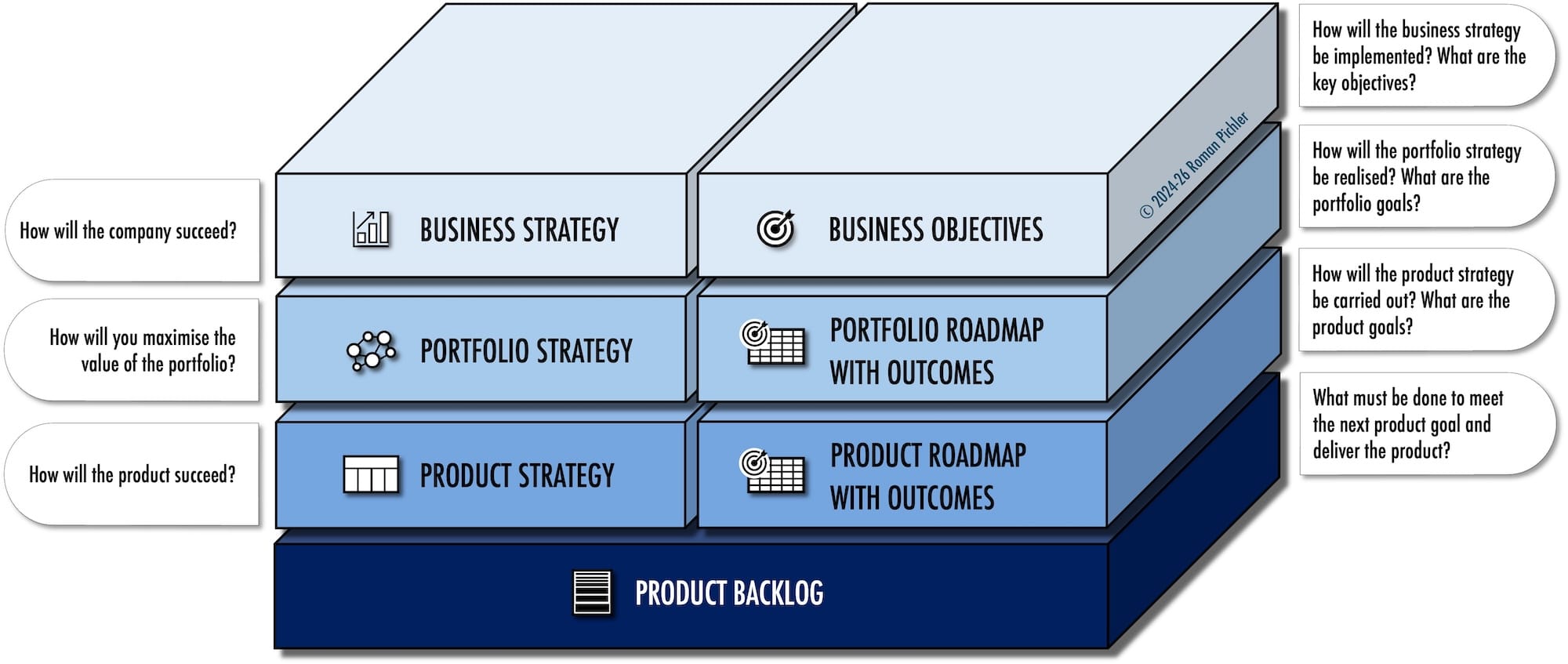
The framework in Figure 1 has four layers, three strategies, and three types of goals.[3] At the top is the business strategy, also referred to as corporate strategy. It describes how the entire company will succeed. Next comes the portfolio strategy, which explains how a group of products will create value together. Underneath it is the product strategy. It communicates how a product will succeed. At the bottom, finally, is the product backlog. While it’s not a strategic plan, I’ve included it to show how strategic decisions are translated into tactical ones.
Next to the three strategies are three different sets of goals: business objectives, portfolio outcomes, and product outcomes. All three state how their respective strategy is likely to be implemented. Whereas a strategy is best understood as a decision-making framework, the objectives state the benefits that should be achieved when the strategy is implemented. To put it differently, the business objectives are derived from the business strategy, the portfolio outcomes from the portfolio strategy, and the product outcomes from the product strategy.
It’s important to note that the strategies and the goals form two hierarchies: Higher-level strategies guide lower-level ones, and higher-level goals direct lower-level ones.[4] This setup creates clarity and alignment, and it ensures that product outcomes are ultimately guided by the business strategy.
| Where’s the Product Vision? To keep the Strategy Stack simple, I’ve decided not to show the product vision as a separate element but to bundle it with the product strategy, as it’s done on my Product Vision Board. The same is true for the business and portfolio vision: I recommend capturing them with the respective strategy. All visions must align, though: The company’s aspiration guides the portfolio vision, which directs the product vision. |
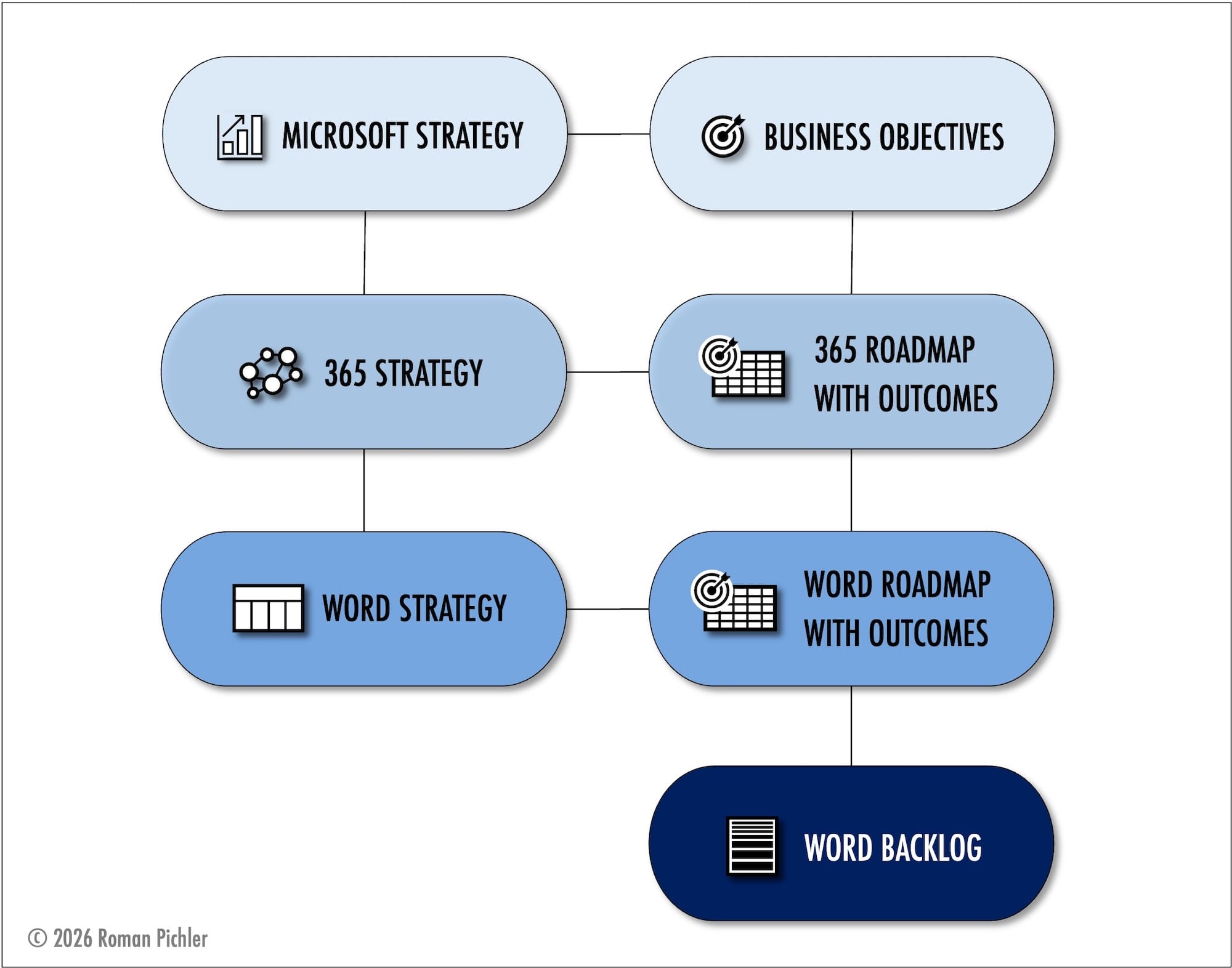
Let’s use an example and explore how the framework might be applied at a company like Microsoft.[5]
The company’s executive leadership team would create an overall business strategy and derive business objectives from it. For the former, a framework like Roger Martin’s Playing to Win might be used, and OKRs might be applied to capture the business objectives.[6]
Based on the business strategy, the company would define a portfolio strategy for each of its product portfolios, such as 365, Xbox, Windows, and Surface. The 365 strategy, for instance, would describe how the productivity suite as a whole—including Word, PowerPoint, and Excel—creates value, using a tool like my Portfolio Vision Board.[7]
To show how the 365 strategy is likely to be implemented, the company would determine portfolio outcomes. These must not only help implement the portfolio strategy—the 365 strategy in Figure 2. They must also support the overall business objectives. This ensures that the different goals are systematically linked. To capture the portfolio outcomes, I recommend using an outcome-based portfolio roadmap like my GO Portfolio Roadmap. Such a roadmap allows you to describe how the portfolio strategy is likely to be realised.
This brings us to the product strategy. Guided by the 365 strategy, a Word strategy would be created alongside separate strategies for PowerPoint, Excel, and the other 365 products. It might state Word’s target markets, user and customer needs, business benefits, and standout features employing, for example, my Product Vision Board.
Using the strategy as a foundation, a set of specific product outcomes is chosen—which must also support the 365 goals. My preference is to use an outcome-based roadmap again, such as my GO Product Roadmap. This allows you to illustrate how the product strategy is likely to be implemented. Finally, the next product outcome is used to focus the product backlog and determine what features should be implemented.
In sum, the Strategy Stack is a framework that offers an integrated approach to making strategic decisions and setting clear goals. Higher-level strategies and goals direct lower-level ones, and goals are based on their corresponding strategy. This way, individual product outcomes are tied to the overall business strategy. To learn more about the framework, read the article The Strategy Stack or watch the equally named video.
| Tailoring the Strategy Stack When you apply the stack, you might find that you have to tailor it to your organisation. If you work for a startup, you are unlikely to require a portfolio layer. Simply adjust the framework and remove the portfolio strategy and outcomes. As a consequence, our business objectives will directly guide the product goals, together with the product strategy. As you create more products or services, (re-) introduce the portfolio layer, create a portfolio strategy and set portfolio outcomes. Similarly, if your company is a large enterprise, you may have to extend the stack and add one or more layers with additional strategies and goals, for example, a business group strategy and business group objectives that sit between the business and portfolio layers. For more advice on tailoring the Strategy Stack, see the article The Strategy Stack. |
Traditionally, it’s the job of the product leader—the Head of Product, Chief Product Officer, VP or Director of Product Management—to ensure that products are aligned with the right business objectives and generate the desired business value. [8]This works as long as the product portfolio is not too big. But the approach does not scale: There is only so much expertise a single person can have and so much work they can cope with. In the worst case, wrong decisions are made at a snail’s pace.
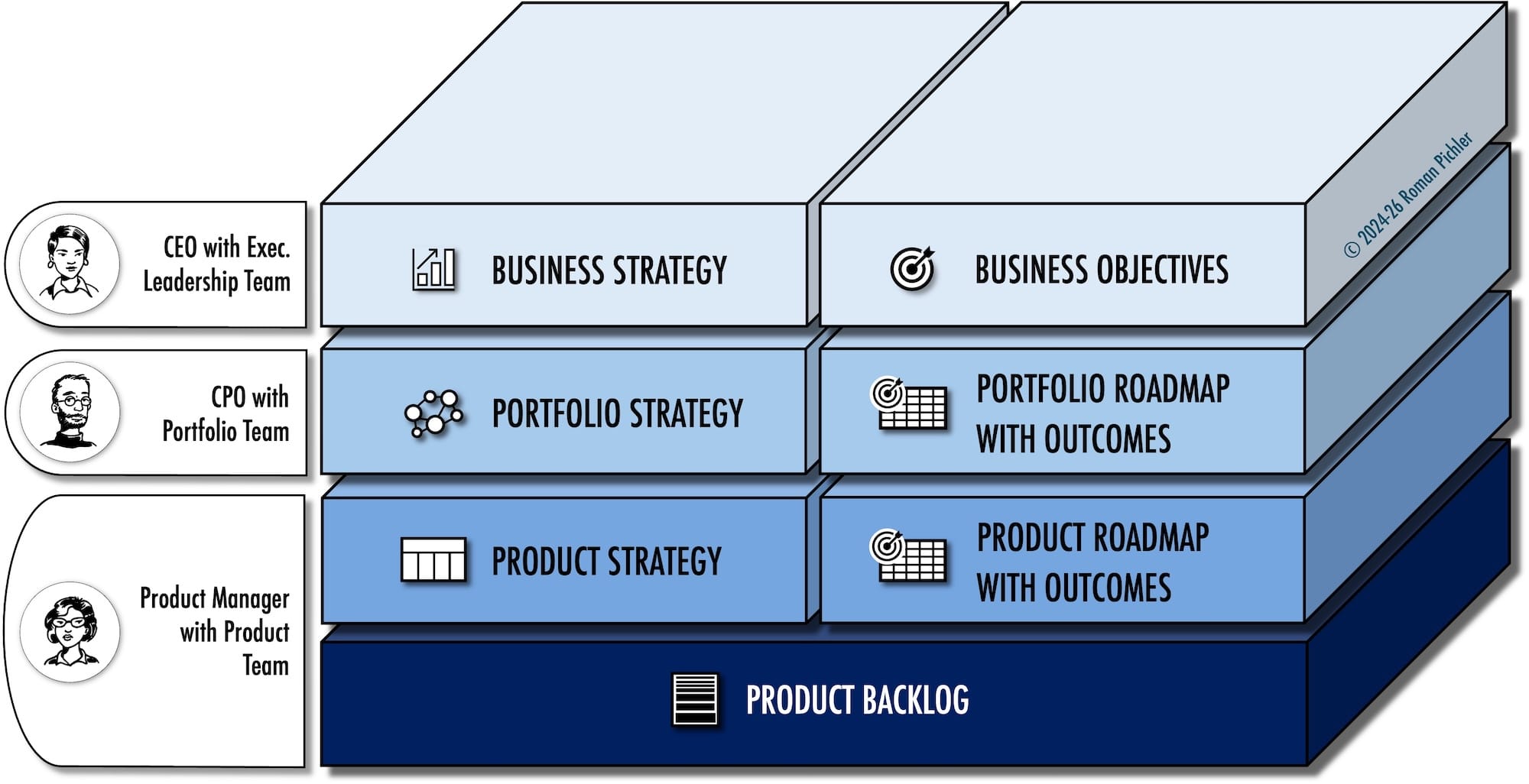
The solution I recommend is to allow product leaders to focus on portfolio management and empower product managers to take ownership of the product strategy. Figure 3 shows how this can be achieved with the help of the Strategy Stack.
Starting from the top, the business strategy and business objectives are set by the CEO and the executive leadership team in Figure 3.[9] The product portfolio strategy and outcomes are created and managed by the product leader, the Chief Product Officer (CPO), together with a portfolio team. Moving down another level, the product strategy, the product outcomes and the product roadmap, as well as the product backlog are owned by a product manager and a product team. This allows the portfolio to grow without risking that the product leader becomes overworked and holds up decisions.[10]
As the strategies and goals in Figure 3 are systematically connected, product managers and product teams must choose product strategies and outcomes that follow the portfolio decisions. This ensures cohesiveness, creates synergy, and prevents different products from going off in diverging directions. At the same time, it gives the product teams the autonomy they need to effectively progress their products, experiment with new ideas, and adapt to changing market conditions and technologies. Alignment and autonomy are balanced.
There is another aspect in Figure 3 I’d like to draw your attention to: Teams are used at all levels. By forming a portfolio team with the product managers as members, the individuals have the opportunity to influence and shape the portfolio strategy and outcomes. This leverages their expertise, creates clarity, and makes it more likely that the product managers correctly apply the portfolio decisions to their products. And by including the Chief Product Officer in the executive leadership team, the individual actively contributes to the business strategy and objectives. This makes it easier for them to make the right portfolio decisions and report to the leadership team how the product portfolio is performing.
Finally, to ensure that the different strategies and goals stay up to date and aligned, you’ll have to review and sync them. This is best done through regular product, portfolio, and business strategy reviews that involve the respective product, portfolio, and executive leadership teams. Start with quarterly workshops and adapt the frequency to your needs—taking into account how changeable the market, the competitive landscape, and the technologies are.
As always, there is no free lunch, and moving from setting product goals in an ad-hoc manner to a systematic approach takes time and effort. My advice is to start with a single portfolio that is not too big, set a portfolio strategy and outcomes, and ensure that the individual product strategies and goals follow them.
If you follow my advice and empower the product managers to make strategic decisions for their products, then allow them to acquire the relevant knowledge, be it by attending a training course or receiving on-the-job coaching. Additionally, give them regular access to users and customers. It’s virtually impossible to build an effective strategy without a deep understanding of the user and customer needs, which is best obtained through interviews and direct observations.
On the plus side, implementing a systematic strategy and goal-setting approach like my Strategy Stack helps you not only make better investment decisions and avoid spending money on products that don’t help the company move forward. It also improves your product operating model and strengthens your overall ability to create value. It’s two birds with one stone, as they say.
[1] According to the report, nearly one-third of respondents state “that their organizations have decided against purchasing at least one software product or feature because they were able to build the functionality in-house using agentic coding tools.” Source: Dan Tinkoff et al, “The State of AI in 2026,” August 2026, Quantum Black, McKinsey and Company.
[2] Note that building a new digital product has historically been cheap compared to the cost of maintaining and evolving it. AI might change this relationship, but you will still have to continue to invest money in an AI product after its launch.
[3] If you are familiar with my earlier work, you may notice that I have changed the framework compared to the original one I published in March 2024. Figure 1 omits the technology strategy and roadmap and introduces business objectives and an outcome-based portfolio roadmap.
[4] While the strategies and goals become more specific and focused as you move from the top to the bottom layer of the stack, all objectives and outcomes should be measurable. You should be able to tell what it takes to meet them and whether they have been achieved.
[5] I use Microsoft and its products, as I hope that you are at least somewhat familiar with them. But I don’t claim that the company works as described in the example.
[6] Lafley, A.G. and Roger L. Martin. 2013. Playing to Win: How Strategy Really Works. Harvard Business Review Press.
[7] An effective product portfolio strategy ensures that the individual products are closely aligned and work together seamlessly: The sum should be greater than the parts. This makes it easier to bundle and cross-sell them. For more guidance, see the article Everything You Need to Know about Product Portfolio Strategy.
[8] For example, Marty Cagan recommends that “team‐specific business objectives are provided to the team by leadership” in his book Inspired, 2nd ed., p. 102. (He reiterates this recommendation in his book Empowered and in a recent article.)
[9] This does not imply, however, that only the executives shape the business strategy and objectives. The opposite is true: I find that a collaborative approach like Strategy Deployment can create a better business strategy and increase its acceptance amongst the employees.
[10] Even if a portfolio grows too big or there are too many portfolios for one person to manage, the framework in Figure 3 offers an effective solution: using one or more full-time portfolio managers to take care of the portfolio work. See the article Everything You Need to Know about Product Portfolio Strategy.
Over the past few years, many product teams have built AI fluency and started to…
“If you are working on something exciting that you really care about, you don’t have…
As product management becomes increasingly data-driven and AI-powered, one human capability is growing in importance:…
One of the biggest mistakes I see product managers make is making decisions in isolation:…
Is it a good thing when product managers are hands-on and use AI to build…
Product outcomes define the specific value a product creates—for users, customers, and the business. When…