Listen to the audio version of this article:
Ethical challenges aren’t new in tech. They date back to the 1940s, the early days of the computer. But it wasn’t until the mid-1960s that the social and ethical consequences of computer technology became more widely acknowledged, driven by computer-aided bank robberies and data privacy issues.[1]
Fast forward to the early 2010s. Video streaming, social media, and cloud computing have not only changed our lives for the better. They have also created a range of new ethical issues. Here are four examples: YouTube recommendations exposed users to harmful content while trying to optimise engagement.[2] Meta was accused of deliberately designing addictive products that hooked young people, leading to mental health issues, including anxiety, depression, and suicide.[3] It Apple took more than 10 years to offer robust parental controls on the iPhone to limit children’s screen time.[4] And the carbon footprint of digital products grew significantly.[5]
With AI, we have gained new, unique capabilities. For us product people, these include customer insight mining, sentiment analysis, and idea generation, as well as the ability to build genuinely new products and features like video generation apps, conversational in-car interfaces, and medical assistants that reduce the workload of healthcare professionals. But at the same time, ethical challenges have become even more serious. Think of the recent OpenAI, Anthropic, and Google cyberattacks where AI agents broke out of testing environments, autonomously accessed external networks, and hacked into companies. Or take the deepfake attack on Arup in 2024 that led to the theft of $25m.[6] And then there is the controversy about new AI data centres due to the land they require and the massive amounts of energy and water they consume.[7]
It would be wrong, though, to assign all responsibility to AI companies like OpenAI, Anthropic, and Google. They certainly have a lot of work to do to prevent further harm. But as more and more products rely on AI, we must all consider the ethical challenges posed, including data privacy, bias and discrimination, intellectual property infringement, misinformation, and environmental impact. Given what’s at stake, we can’t afford any longer to ignore product ethics and hope for the best. We must take responsibility and ensure that the products we build are indeed non-harming: that they don’t cause harm to the users, society, and the planet.
You’d be forgiven for thinking that applying AI checklists and writing evals is all you need to do to prevent ethical issues. While these are undoubtedly helpful, they are not enough. As long as we consider ethicality primarily during product delivery, we treat it as an afterthought. This carries the risk of overlooking problems: The longer you work on a product, the more attached you become to it, and the harder it gets to be objective and challenge your decisions. Additionally, you might be hesitant to make bigger changes at this stage to avoid delaying the release and disappointing customers and stakeholders.
The solution I recommend is designing ethicality into the innovation process. The ethical impact of a product must be considered early on when you determine who the users are and why they would benefit from the product, whether it’s feasible to build it, and whether it can be monetised. In other words, ethics must play a key role in making strategic product decisions and in deciding whether to build a product. It must be seen as being central to achieving product success—just as important as desirability, feasibility, and viability.[8]
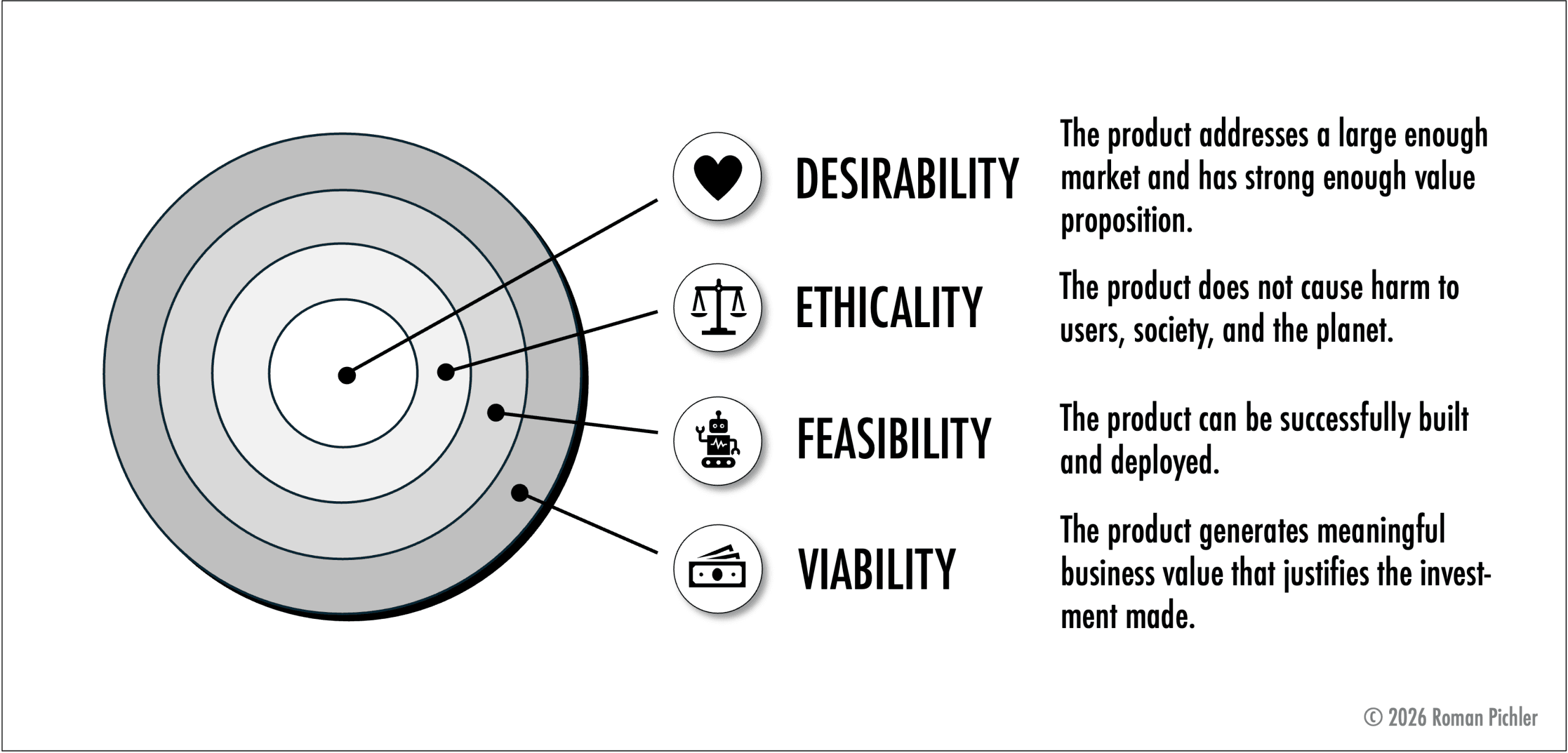
Figure 1 shows desirability, ethicality, feasibility, and viability as four success factors together with their priorities. The most important factor is desirability. For any product to be successful, it must be desirable. It must address a large enough market and have a strong enough value proposition. It must solve a real problem or offer a tangible benefit for the users and customers, and it must stand out from competing offerings. To put it differently, if the market is too small or too heterogeneous, if the need it addresses is too weak, and if the product is not properly differentiated, it is unlikely to be successful.
The second most important success factor is ethicality. Once you are confident that the product is likely to be desirable, check if it will also be ethical. Ask whether it will be fair and inclusive; whether it will not negatively impact the users’ privacy, safety and well-being; and whether it will respect the users’ agency, allowing them to make informed choices and have control over the product. Additionally, explore its environmental impact. Check whether it will contribute to pollution and climate change by how it is developed, provided/hosted, and—if it includes hardware and plastics—manufactured, delivered, and disposed of. Only because there is a market for a product, this does not mean that you should automatically build it. Instead, you should check that it will be ethical. This is no selfless act: It will protect the brand and prevent product liability issues.
Assuming that the product will be desirable and ethical, explore if it is feasible—that you will be able to successfully develop it. Consider not only if the necessary technologies exist but also if there are enough people in your company who have the right skills and can work on the product. If that’s not the case, check if it’s realistic to train the individuals and/or hire people with the desired expertise.
Finally, assess if the product will generate enough value for the business to justify building it. Will it, for example, generate revenue directly or indirectly, reduce cost, increase productivity, or increase brand value? What business model will be used to generate the desired business benefits? And what does it take to apply the business model successfully, including establishing the right customer relationship and using the right sales and marketing channels?
It’s important to note that the four factors interact and influence each other. For example, the business model you choose to monetise a revenue-generating product should support ethicality, be fair to all parties, and be environmentally sustainable. This may change the initial business model choice, and it may impact, for example, the supplier selection, the pricing model, and the distribution channels. The prioritisation shown in Figure 1 does therefore not imply that you should follow a linear process when building a product strategy. The opposite is true. Strategy discovery is best understood as an iterative process.
If you are familiar with my work, you’ll know that I always recommend making strategic decisions explicit and capturing a product’s target market, needs, standout features, and business benefits using a tool like my Product Vision Board. Once you’ve done this, you can use the four success factors to uncover hidden assumptions and risks. Addressing desirability, ethicality, feasibility, and viability risks will result in a validated product strategy. Such a strategy is the foundation for building a successful and ethical product.[9]
As important as it is to integrate ethicality into the strategy discovery work, it is not enough. An effective strategy helps us shape the future and build a desirable, ethical, feasible, and viable product. But it’s no guarantee. If you don’t measure the actual impact your products have on the users, society, and the planet, your product decisions might be increasingly guided by financial considerations. This risks creating blind spots and ignoring ethical issues.
You should therefore adopt metrics that help you clearly measure how ethical your product is in addition to using financial and customer KPIs, such as monthly recurring revenue and daily active users. These may include the following indicators:
As is the case with all KPIs, you will have to determine what the right ethicality metrics for your specific product are. They will differ depending on its type/category, as well as your organisation’s Environmental, Social, and Governance (ESG) standards.
For a social media product, you should also track, for instance, misinformation spread rate—the speed and reach of flagged false information before it is moderated or fact-checked—and toxicity and harassment prevalence—the percentage of views or interactions that contain hate speech, bullying, or harassment. And for a hardware-based product, you should measure the e-waste generated and the recycled/reused hardware rate.
Whatever indicators you choose, make sure they give you a clear understanding of the impact your product is having so that you can take the right actions and prevent further harm.
The central ethical challenge of digital products today is balancing innovation and commercial success with respect for human agency and the well-being of people and the planet. Given the rapid development of AI, we can’t afford any longer to treat ethicality as a nice-to-have, as something optional. Instead, we must see it as central to product success: A product can only be successful if it is ethical, no matter how much revenue it might generate. Consequently, we should not offer products that can cause harm to individuals, society, and the environment, even if others are doing it. Ethics is not something that sits outside product management. As product leaders and product managers, we have to take responsibility and put ethics at the centre of our decisions.
[1] MIT professor Norbert Wiener founded computer ethics as a field of study in the 1940s. See Terry Bynum’s article “A Very Short History of Computer Ethics.”
[2] Muhsin Yesilada and Stephan Lewandowsky. 2022. “Systematic review: YouTube recommendations and problematic content.”
[3] After a multi-state lawsuit in the US, Meta agreed to make several changes to the way Instagram and Facebook operate, including daily usage limits and blocks on nighttime use for younger users, in addition to an $18 billion settlement.
[4] Apple introduced screen time in iOS 12 in 2018. The first iPhone launched in 2007.
[5] Recent research suggests that the energy consumption of the information and communication technology (ICT) sector has not been correctly accounted for and that its impact has been worse than thought. See, for example, Robert Istrate et al. 2024. “The environmental sustainability of digital content consumption.”
[6] Adaptive Team. 2026. “Deepfake Attack Examples: 11 Real-World Cases of AI Voice Cloning, Video Impersonation, and Synthetic Media Fraud.”
[7] See, for example, Hettie O’Brien. 2026. Wednesday briefing: What’s behind the global backlash against datacentres? First edition newsletter, The Guardian, and the Wikipedia article “Opposition to AI data centers.”
[8] Desirability, feasibility, and viability were, to my knowledge, first suggested by Tim Brown in his book Change by Design who referred to them as competing constraints that must be balanced to offer successful products.
[9] I first wrote about desirability, feasibility, and viability in an article in 2012, and I recommend using the three factors to identify and address risks in a product strategy in the first edition of my book Strategize, published in 2016. The second edition refines this approach and adds ethicality as a fourth success factor. See also my articles Product Strategy Discovery and Four Product Success Factors.
Every product has to create real value for a group of people and the business,…
Over the past few years, many product teams have built AI fluency and started to…
“If you are working on something exciting that you really care about, you don’t have…
As product management becomes increasingly data-driven and AI-powered, one human capability is growing in importance:…
One of the biggest mistakes I see product managers make is making decisions in isolation:…
Is it a good thing when product managers are hands-on and use AI to build…